What Perplexity Actually Is
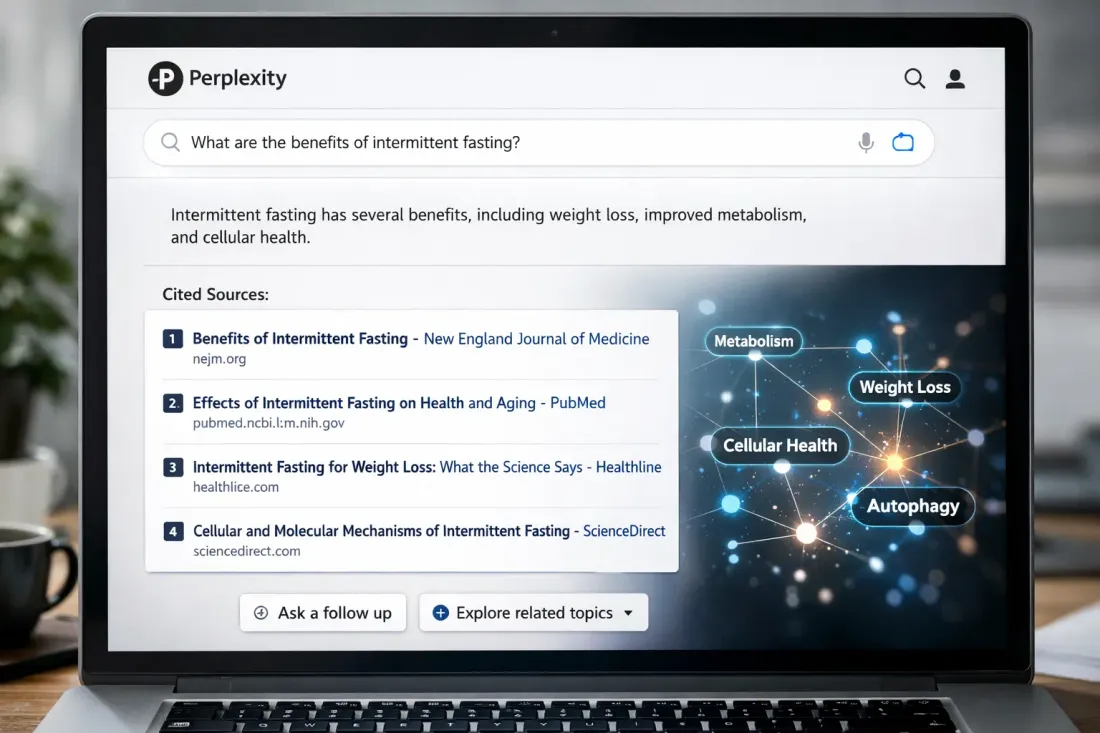
Perplexity is an AI search engine that reads the web in real time and produces cited, synthesised answers rather than a list of links.
You ask a question; it searches, reads the relevant sources, and writes a direct answer with numbered citations you can verify. It is closer to having a research assistant than to using a search engine.
This review is based on Perplexity’s documentation, pricing pages and published reviews, not our own testing. Typical uses include competitive analysis, technology comparisons, fact-checking, industry news, and general knowledge queries.
What Perplexity Does Better Than Google
Research Synthesis
For a complex research question, “What are the main differences between LLMs and traditional search engines, and how has this changed content discovery in 2025 and 2026?”, Perplexity produces a structured, cited answer.
Getting the same quality of synthesis from Google requires:
- Opening 8 to 10 tabs
- Reading multiple articles
- Doing the synthesis yourself
For research-heavy work, Perplexity saves significant time.
Follow-up Questions
Perplexity maintains context across a conversation. After getting an initial answer, you can ask:
- “Go deeper on point 3”
- “What are the counterarguments to this?”
- “Compare this with [alternative]”
It builds on the previous response. Google resets with every new search. This conversational research model is genuinely more productive for multi-part research tasks.
Citing Sources You Can Trust
Every claim in a Perplexity answer is numbered and linked. You can spot-check any fact by clicking the citation.
Google shows you where to look; Perplexity shows you what it found and lets you verify.
Where Google Still Wins
Perplexity struggles with:
- Local queries: “restaurants near me”
- Shopping searches: comparing prices across retailers
- Navigational searches: going to a specific website
- Very recent events: 24 to 48 hour lag for breaking news
The Accuracy Caveat
⚠️ Important: Perplexity can be confidently wrong. It synthesises information from sources it retrieves, and if those sources contain errors or the question requires subtle judgment, the answer can look authoritative while being incorrect.
This is not unique to Perplexity, all AI search tools have this problem, but it matters for high-stakes research where you would verify every claim anyway.
Perplexity vs Google vs ChatGPT
| Feature | Perplexity | ChatGPT | |
|---|---|---|---|
| Direct answers | ✅ | Partial | ✅ |
| Citations | ✅ | Links only | Check the current product |
| Real-time data | ✅ | ✅ | Limited |
| Follow-up context | ✅ | ❌ | ✅ |
| Local search | ❌ | ✅ | ❌ |
| Shopping | ❌ | ✅ | ❌ |
| Ads | ❌ | ✅ | ❌ |
Is Pro Worth It?
Perplexity’s plans page (read 29 Sep 2026) shows Pro at US$17 a month “or equivalent, billed annually” and Max at US$167; we did not read a monthly-billing price on that page. The Pro plan lists:
- Deep research
- A choice of AI models
- Extended access to Perplexity’s Computer agent and 4,000 bonus credits
- Larger usage limits and memory
The page does not publish free-tier limits, so “unlimited” claims for the free tier are not supported here. Full plan detail: Perplexity review.
Verdict
Pro is likely worth it if you run a high volume of significant research tasks each month, since Pro Search is positioned by Perplexity for more complex queries.
The free tier is sufficient if you use Perplexity occasionally for simple questions.
Summary
A strong option for AI-assisted research in 2026, and its free tier is widely regarded as generous.
Best for:
- Researchers and academics
- Content creators who need facts
- Professionals making data-driven decisions
- Students writing papers
- Anyone tired of scrolling through SEO-optimized fluff